LINQ vs Stored Procedures
INTRODUCTION
This post aims to examine two approaches to querying data in C# applications: LINQ and stored procedures (SProcs). The discussion considers the characteristics, advantages, and limitations of each approach. Such an analysis is valuable because even experienced developers may not be familiar with the full range of available options. Introducing these approaches early in programming education, including computer science classes, can help learners understand the alternatives and make informed decisions about which approach best suits their needs.
The following objectives support this aim:
Review the rules and conventions governing query syntax;
Provide an overview of each selected approach;
Analyze their respective advantages and disadvantages;
Compare the two approaches based on their characteristics, strengths, and limitations.
The paper begins with a brief discussion of query optimization. Examples of SQL (Structured Query Language)¹ queries are used to illustrate principles of query construction, supported by diagrams showing SQL query structures.
It then examines the nature of LINQ (Language Integrated Query), its variants, and the advantages and disadvantages associated with its use. Examples illustrate LINQ query syntax.
Stored procedures are subsequently discussed as an alternative approach to querying data, using a similar descriptive framework.
The conclusion summarizes the strengths and weaknesses of each approach, offers the author’s assessment of their suitability, and identifies relevant areas of computer science education.
QUERY OPTIMIZATION
Modern database management systems (DBMSs)² incorporate optimizers that consider execution costs. During SQL query processing, a query can be represented as a tree structure, which facilitates syntactic⁴ and semantic⁵ analysis. Syntactic validation is performed first, followed by semantic validation to identify possible violations of semantic rules.(Вълова & Калмуков, 2003)
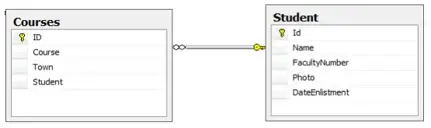
Figure 1. Example database
Consider a database (DB)³ containing the fields shown in Figure 1. To retrieve information from this database, we use the query structure illustrated in Figure 2.

Figure 2. SQL query
The attributes used to construct the query determine the tree structure illustrated in Figure 3, which is developed using algebraic operations.
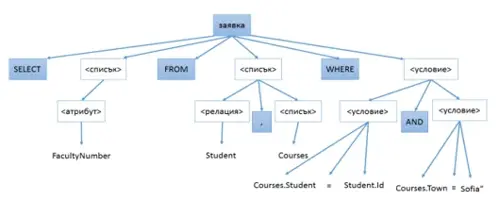
Figure 3. Tree structure
During construction, several aspects of the query are checked: (Вълова & Калмуков, 2003)
Whether the SELECT and WHERE clauses correspond to the defined relations;
Whether these clauses are correctly and completely specified;
Whether data types are used correctly and are compatible with their roles in the query.
Several recommendations are presented for writing SQL queries: (Вълова & Калмуков, 2003)
Use an id column with PRIMARY KEY and auto-increment attributes for each table;
Retrieve only the required columns, for example, SELECT col1, col2, col3 FROM …;
Create indexes on table columns to facilitate subsequent filtering operations;
Prefer JOIN operations to subqueries where this improves query execution speed;
Ensure compatible column types when joining tables;
Prefer a query with appropriate selection criteria to issuing several separate queries;
Use the % wildcard in LIKE comparisons carefully to avoid unintended results.
LINQ
LINQ, an abbreviation of Language Integrated Query, is a Microsoft .NET technology designed to make working with data more convenient and intuitive.
LINQ enables developers to express queries using syntax integrated into languages such as C# and VB.NET. Depending on the provider, LINQ can query collections and a variety of data sources (Magennis, 2010).
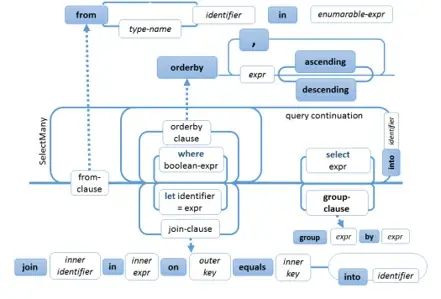
Figure 4. LINQ syntax (Albahari & Albahari, 2012)
Figure 4 presents the general syntax of a LINQ query. Figure 5 provides an example that retrieves city names beginning with the letter “S” and then orders them by name length. The ordering operation uses a lambda expression⁶.(Albahari & Albahari, 2012)

Figure 5. General LINQ query syntax (Albahari & Albahari, 2012)
The example query (bTowns) retrieves data from a list of strings (towns), filters the entries by their initial letter, and sorts the results by string length.
A LINQ query expression begins with the from keyword, followed by the source collection (in towns). When filtering is required, a where clause is added (where town.StartsWith("s", true, null)). In this example, the selection criterion is that the city name begins with “s”. After filtering, the results are ordered by the length of each name using OrderBy(i => i.Length).
The query shown in Figure 5 displays each resulting city name on the screen.
As Figure 5 illustrates, the explicit structure of LINQ query syntax can facilitate understanding. This is particularly beneficial in educational settings, where learners can observe the individual operations applied to the data.
Advantages:
Syntax Highlighting: LINQ benefits from syntax highlighting in modern development environments, which facilitates error identification during the development process.
IntelliSense Support: LINQ integrates with IntelliSense, providing intelligent code completion and suggestions that enable developers to write queries more efficiently and accurately.
Reduced Development Time: LINQ simplifies query implementation and accelerates code development, thereby reducing the overall time required for application development.
Simplified Debugging: LINQ's seamless integration with the C# programming language facilitates debugging and error identification within the development environment.
Efficient Management of Table Relationships: LINQ provides a structured and intuitive approach to managing relationships between database tables, enabling developers to construct JOIN queries more efficiently.
Versatile Data Retrieval: LINQ enables developers to retrieve a wide variety of data through a consistent query syntax, reducing the need for multiple query implementations.
Extensibility: LINQ is highly extensible, allowing developers to apply their existing knowledge and query-building techniques to different types of data sources.
Query Composition and Integration: LINQ supports query composition and the integration of multiple data sources. Furthermore, it enables complex data retrieval operations to be divided into smaller, more manageable queries, improving code readability, maintainability, and debugging.
Data Transformation Capabilities: LINQ provides an efficient mechanism for transforming data between different formats and representations, such as converting relational database data into XML structures.
Disadvantages:
Query Compilation Overhead: LINQ queries may introduce additional compilation and query translation overhead, potentially increasing execution time, particularly when queries are repeatedly processed without effective caching mechanisms.
Complex Query Implementation: LINQ may be less suitable for implementing highly complex database queries, particularly those requiring advanced SQL features or database-specific optimizations.
Performance Degradation: Improperly constructed or inefficient LINQ queries can negatively affect application performance, resulting in increased execution times and unnecessary resource consumption.
Application Recompilation and Deployment: Modifying LINQ queries embedded within application code typically requires recompiling the application and redeploying the updated assemblies, such as Dynamic Link Library (DLL) files, to the server.
Potentially Increased Response Time: Depending on query complexity, implementation, and the underlying data access technology, LINQ queries may exhibit longer response times compared to optimized database-specific queries or stored procedures.
Types of LINQ Queries
Microsoft provides several LINQ providers for different data manipulation requirements (see Figure 6). These providers allow developers to apply LINQ concepts to additional data sources (Calvert & Kulkarni, 2009).
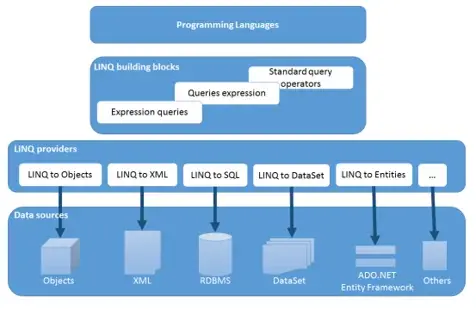
Figure 6. Diagram of LINQ providers (Marguerie, Eichert, & Wooley, 2008)
LINQ to Objects
LINQ to Objects provides a set of standard query operators for working with data held in memory (Magennis, 2010).
It supports queries over C# objects such as arrays, lists, and other collections. Queries can return sequences implementing IEnumerable, allowing developers to filter collections with relatively little code (Magennis, 2010).
LINQ to ADO.NET
LINQ to ADO.NET encompasses LINQ technologies for accessing data associated with database systems such as Microsoft SQL Server and other relational databases. It includes the following approaches (Pialorsi & Russo, 2007)
LINQ to SQL
LINQ to SQL was developed specifically for SQL Server databases. Application objects are first mapped to the relational database, either manually or with the Object Relational Designer (ORD)⁷. LINQ to SQL then handles communication with the database during execution (Vatsa, 2012)
Introduced alongside Visual Studio 2008, LINQ to SQL provides strongly typed data access. It was designed to accelerate application development, particularly for relatively straightforward object–relational mappings (Flasko & Microsoft Corporation, 2018).
By default, LINQ to SQL translates query expressions into the corresponding SQL statements during execution (Flasko & Microsoft Corporation, 2018).
LINQ to DataSet
LINQ to DataSet offers a convenient way to query data cached in a System.Data.DataSet⁸. It is useful when working with a disconnected copy of data retrieved from an external source. Internally, a DataSet represents related tables, constraints, and relationships; in this respect, it resembles an in-memory relational database (Erickson, 2009).
LINQ to Entities
LINQ to Entities comprises query operators used to retrieve data through the ADO.NET Entity Framework (Skeet, 2013).
It uses the Entity Data Model (EDM)⁹ as a conceptual representation of data and enables queries to return collections of objects corresponding to information stored in the underlying database.
LINQ to XML
LINQ to XML combines capabilities associated with the Document Object Model (DOM)¹⁰ and the expressive querying concepts of XPath and XQuery¹¹ to manipulate and retrieve data from XML documents (Pialorsi & Russo, 2007).
The System.Xml.Linq namespace contains the classes used for LINQ to XML (Pialorsi & Russo, 2007).
PLINQ (Parallel LINQ)
PLINQ was introduced with .NET Framework 4.0 and Visual Studio 2010 to make parallel programming more accessible to developers. It enables certain query operations to be partitioned into tasks that execute concurrently (Magennis, 2010).
STORED PROCEDURES
Stored procedures (SProcs) are reusable database routines containing one or more Transact-SQL (T-SQL)¹² statements. The source describes them as precompiled groups of statements associated with an execution plan. Executing multiple operations through a single procedure call can reduce network traffic and may improve performance.
Stored procedures can be invoked repeatedly by an application and contain program logic that performs operations within the database (O’Neil, 2016).
Compared with the LINQ query expression in Figure 5, the syntax presented in Figure 7 is shorter and appears more concise.

Figure 7. Syntax presented as an SProcs example
The example uses the Where method to select array elements whose names begin with “S”, with StartsWith specifying the matching criterion. The Where expression replaces the query-expression clauses from from through select in the example shown in Figure 5.
Advantages:
Support for Complex Queries: Stored procedures facilitate the implementation of complex database queries and operations, allowing developers to incorporate advanced SQL statements, conditional logic, and multiple data manipulation operations within a single executable procedure.
Reduced Network Traffic: Stored procedures can minimize network communication overhead by executing multiple database operations within a single procedure call.
Execution Plan Caching: Database management systems can cache execution plans for stored procedures, reducing the overhead associated with repeated query optimization and compilation. Furthermore, executing multiple SQL statements through a single procedure call can reduce the number of network round trips between the application and the database server.
Enhanced Security: Stored procedures can provide an additional layer of database security by controlling access to underlying database objects and operations.
Controlled Data Access: When a stored procedure is invoked over a network, it executes predefined database operations using the supplied parameters. Appropriate permission configurations allow applications to execute stored procedures without requiring direct access to the underlying database tables, thereby reducing the exposure of sensitive database structures.
Improved Maintainability: Stored procedures provide a centralized mechanism for managing database operations, facilitating maintenance, updates, and dependency management.
Centralized Database Logic: By storing procedural SQL scripts within the database, developers can more efficiently manage modifications and track dependencies resulting from database schema changes. Additionally, stored procedures can be tested and validated independently of the applications that invoke them.
Potentially Faster Response Times: Stored procedures can improve database response times by reducing communication overhead and optimizing the execution of database operations.
Efficient Procedure Execution: When invoking a stored procedure, the application typically transmits the procedure name and the required parameter values rather than sending the complete SQL statements. This approach can reduce network traffic and improve execution efficiency, particularly for complex operations involving multiple database interactions.
Disadvantages:
Increased Debugging Complexity: Debugging stored procedures can be more challenging than debugging application-level queries due to their execution within the database environment. Identifying and resolving errors may require specialized database debugging tools and additional expertise in SQL and database management systems.
Limited Database Portability: Stored procedures are not always portable across different database management systems (DBMSs) due to variations in SQL dialects, procedural syntax, and supported features. Consequently, migrating stored procedures between database platforms may require significant modifications to ensure compatibility and maintain functionality.
TYPES OF STORED PROCEDURES
User-defined stored procedures. These procedures can be created in a user-defined database or another database, excluding the resource database.
System stored procedures. These procedures are physically stored in a hidden resource database and are logically accessible through the system schema.
Temporary stored procedures. These are a category of user-defined stored procedures created for temporary use.
Remote stored procedures. These are created and stored in a database on a remote server and can be accessed from another server.
CONCLUSION
As discussed above, both approaches have distinct advantages and limitations.
LINQ is useful for expressing JOIN operations because its query syntax can provide a detailed, structured representation of the logic. Integration with the programming language and development tools can also simplify debugging and help break complex problems into smaller operations. From an educational perspective, this explicit structure may help learners understand how a query works. However, poorly constructed LINQ queries may lead to performance problems, and some queries can require more code or additional processing.
Stored procedures, in turn, support complex database operations while offering a concise interface to the application. The source argues that they may be particularly convenient in larger projects. Their limitations include potentially more difficult debugging and reduced portability between database platforms because of differences in supported SQL dialects and features.
Ultimately, the appropriate approach depends on the application and developer requirements. Based on the author’s experience, stored procedures can reduce the amount of application-side query code and may simplify the handling of database operations in client projects. They may also reduce confusion associated with lengthy query expressions.
This article may be used as supporting material in the “Databases” curriculum developed by the Bulgarian Ministry of Education and Science under the “Applied Programmer” vocational initiative, particularly in the modules “Queries for Data Retrieval and Modification” and “Complex Data Retrieval Queries”.
- NOTES
-
SQL (Structured Query Language) is a language used to define, manipulate, and retrieve data in relational database management systems (Skeet, 2013).
Database (DB): a collection of contextually related data maintained over time and organized to support efficient use.
Database management system (DBMS): software used to create, maintain, and manage databases. Examples include Microsoft SQL Server, MySQL, and Access.
Semantics: rules determining the meaning of syntactically valid constructs; answers the question “What does it do?”
Syntax: rules determining how constructs are written in a programming language; answers the question “How is it written?”
Lambda expressions: expressions that operate on individual elements of input data rather than on the collection as a whole (Sur, 2009).
Object Relational Designer (ORD): a graphical Visual Studio tool for generating object classes.
System.Data.DataSet: a component of ADO.NET providing classes for managing sets of data (Flasko & Microsoft Corporation, 2018).
Entity Data Model (EDM): a set of concepts used to describe data structures (Albahari & Albahari, 2012).
Document Object Model (DOM): an interface for representing XML or HTML documents as a tree of nodes.
XPath and XQuery: technologies used to navigate and query elements and attributes in XML (eXtensible Markup Language) documents (Pialorsi & Russo, 2007).
Transact-SQL (T-SQL): an extension of SQL that supports procedural programming, local variables, and functions for manipulating dates, text, and other data (O’Neil, 2016).
- REFERENCES
-
Albahari, J., & Albahari, B. (2012). C# 6.0/5.0 in a Nutshell. O’Reilly Media. Извлечено от https://itbook.store/books/9780596800956
Calvert, C., & Kulkarni, D. (2009). Essential LINQ. Addison-Wesley. Извлечено от https://itbook.store/books/9780321564160
Erickson, C. (2009). OBJECT ORIENTED PROGRAMMING. Извлечено от https://atomicobject.com/uploads/archive/files/ObjectOrientedProgramming.pdf
Flasko, E., & Microsoft Corporation. (2018). Introducing LINQ to Relational Data. Microsoft Corporation. Извлечено от https://msdn.microsoft.com/en-us/library/cc161164.aspx
Klein, S. (2008). Professional LINQ. Wrox. Извлечено от https://people.inf.elte.hu/amargo/Books/Professional%20LINQ%20(Programmer%20to%20Programmer).pdf
Magennis, T. (2010). LINQ to Objects Using C# 4.0. Addison-Wesley. Извлечено от http://bellasportsskole.dk/media/38600/linq_to_objects_using_c__4.0.pdf
Marguerie, F., Eichert, S., & Wooley, J. (2008). LINQ in action. Manning. Извлечено от https://itbook.store/books/9781933988160
O’Neil, T. (2016). SQL Server Stored Procedures – Fundamentals. Извлечено от https://www.sql-server-performance.com/w2k-filesystem-affects-performance/
Pialorsi, P., & Russo, M. (2007). Introducing Microsoft LINQ. Microsoft Corporation. Извлечено от https://pedrogalvaojunior.files.wordpress.com/2011/04/introducing-microsoft-linq.pdf
Skeet, J. (2013). C# in depth. Manning. Извлечено от https://itbook.store/books/9781617291340
Sur, A. (March 2009 r.). Basics of LINQ and Lamda Expressions. Извлечено от https://www.codeproject.com/Articles/33769/Basics-of-LINQ-Lamda-Expressions
Vatsa, A. K. (2012). Beginning LINQ. Microsoft Corporation. Извлечено от https://www.itorian.com/2012/09/BeginningLINQbyItorian.com.html
Vigilant Solutions. (2014). SQL Server stored procedures and LINQ: A comparison. Vigilant Solutions. Извлечено от http://vigilantsolutions.com.au/software-development/advantages-linq-over-stored-procedures/
Вълова, И., & Калмуков, И. (2003). Оптимизация на SQL заявки. Русе: Русенски университет “Ангел Кънчев”, том 52. Извлечено от https://conf.uni-ruse.bg/bg/docs/cp13/3.2/3.2-30-1.pdf